BLOG
The french painter Camille Corot once said: "I hope with all my heart there will be painting in heaven."
Here is the original quote: "Malgré moi, je continue à espérer.
J'espère de tout mon coeur qu'il y aura de la peinture au paradis."
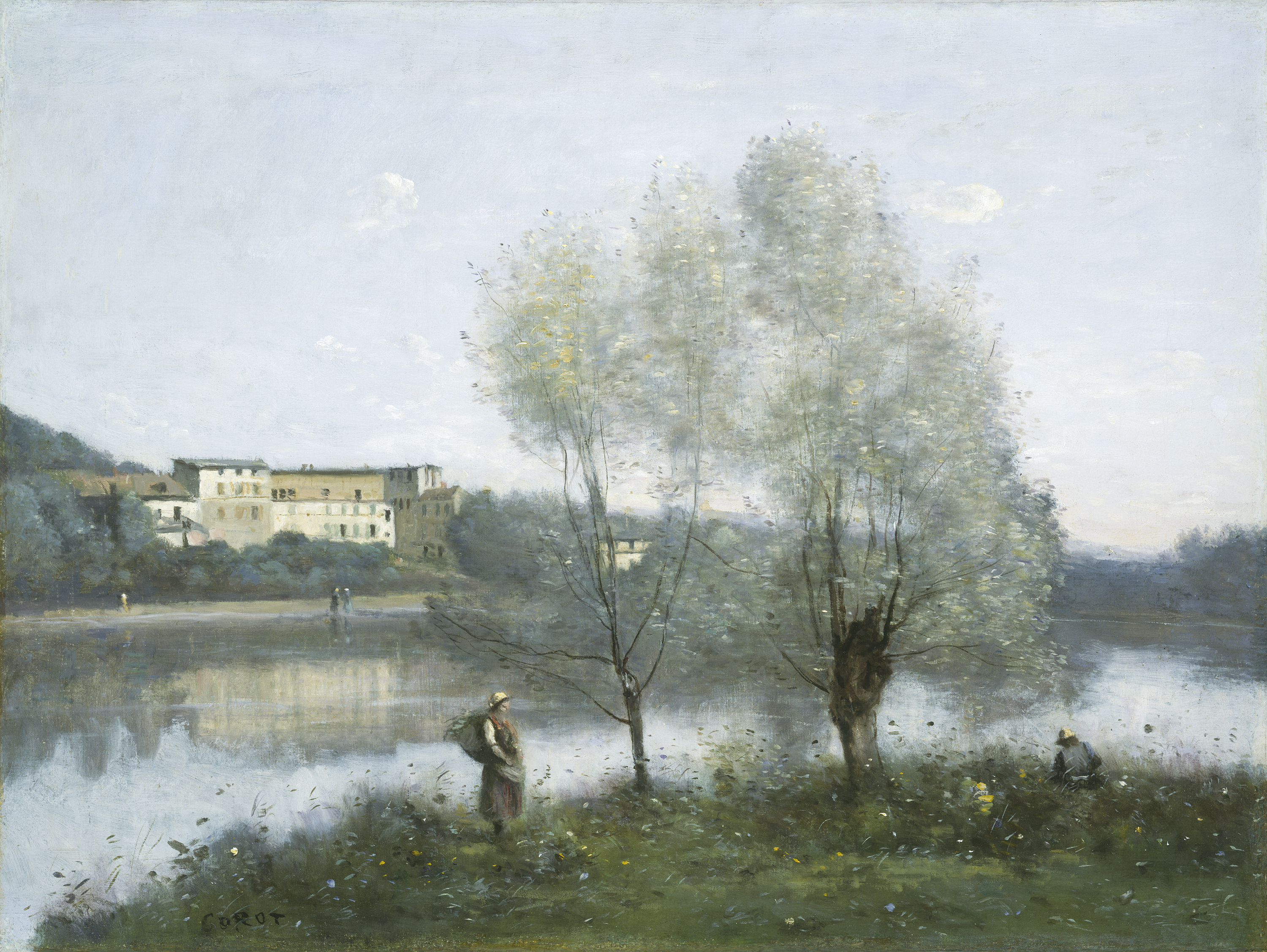 National Gallery of Art: Corot, Ville d'Avray, 1865
What is Eggtempera?
This is what a 515 year old eggtempera painting looks like:
Michelangelo | Manchester Madonna | The National Gallery, London:

The Manchester Madonna (The Madonna and Child with St. John and Angels, c.1497) is an unfinished painting by Michelangelo and shows the green underpaint used for fleshtones in the unfinished sections of the painting. One can also see hatching in some areas of the rope as underpainting.
Cologne Cathedral
Images from inside the Cathedral
few photos I captured with my iPhone during a recent visit to the cathedral.
Why Eggtempera is still a valid painting medium today
I painted the painting below many years ago and the colors are unchanged as if they had been applied yesterday.
It's usually not recommended to paint on canvas, but here, because it was one of my first attempts at egg tempera painting, I used canvas.
The acrylic ground and surface structure of the canvas was absorbent enough to hold the egg tempera color extremely well. I moved a few times and finally cut the canvas from the frame and stored it flat.
To this day, the paint is completely unchanged.

A REGION AT THE FRONT OF THE BRAIN 'LIGHTS UP'
when we experience beauty in a piece of art or a musical excerpt, according to new research funded by the Wellcome Trust.
Beauty is in the Medial Orbio-Frontal Cortex of the Beholder
"The study, published July 6 in the open access journal PLoS One, suggests that the one characteristic that all works of art, whatever their nature, have in common is that they lead to activity in that same region of the brain, and goes some way to supporting the views of David Hume and others that beauty lies in the beholder rather than in the object."
"However, particularly interesting was that activity in another region, the caudate nucleus, found near the centre of the brain, increased in proportion to the relative visual beauty of a painting. The caudate nucleus has been reported previously to correlate with romantic love, suggesting a neural correlate for the relationship between beauty and love."
Jean-Baptiste Camille Corot (1798-1875) also said this about the painting process:
"Be guided by feelings alone... before any site and any object, abandon yourself to your first impression. If you have really been touched, you will convey to others the sincerity of your emotion."
Visual art differs from music in that there is an additional intellectual filter through which everything we see must pass.
Therefore to create an image that is true to the emotion experienced when we look at he world, we must alter the image in ways that reflect this experience.
Citations d'artistes expliquées
Photography and Sketching
Not too long ago artists had to rely on their sketchbooks to record the visual world around them.
Today we use photography for the same purpose. It's a way to keep a log of what we have seen, places we've visited, a source of inspiration for painting.

As a painter I collect thoughts.
My thoughts are about color and form.
I let my mind fall into the unknown.
I chase impressions of beauty for a while.
I will try to talk about what I have seen in my paintings.
But paintings will always take on a life of their own.
I lived under a southern sun and blue skies. I walked with African dogs on dry earth. I come from northern Europe where as a child I crossed a fortified border into a forbidden country. I played in a garden that was once maintained and has since returned to wilderness.
The cathedrals of Europe are collective memories of magical gathering places in the shade under giant trees.
The world is very different now.
C O N T A C T
Ute Merbitz
Email: ute@power.net
